
Forensic Expert Witness Testimony in Canadian Courts: The R. v. Mohan Admissibility Test, Rule 52 Expert Reports & Cross-Examination Defense for Litigators
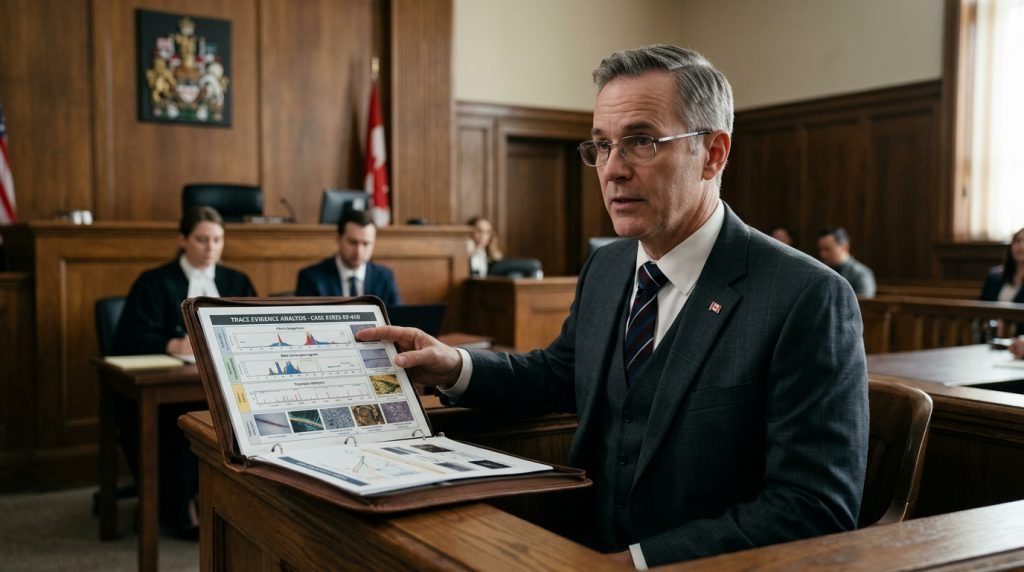
In high-stakes civil litigation, catastrophic personal injury trials, corporate fraud prosecutions, and criminal proceedings across Canada, trials rarely hinge on simple factual testimony. Instead, judicial outcomes depend on the credibility, scientific validity, and persuasiveness of expert opinion evidence. For trial lawyers appearing before the Court of King’s Bench of New Brunswick, the Supreme Court of Nova Scotia, and Canadian Federal Courts, securing accredited forensic expert witness testimony provides the definitive evidentiary weight required to prevail at trial. What Are the Legal Requirements for Forensic Expert Witness Testimony in Canadian Courts? Direct Answer: Canadian Forensic Expert Witness Admissibility To be admissible in Canadian courts, forensic expert witness testimony must satisfy the landmark Supreme Court of Canada four-part test established in R. v. Mohan [1994]: (1) logical and legal relevance, (2) necessity in assisting the trier of fact, (3) absence of any statutory or common law exclusionary rule, and (4) a properly qualified expert. Furthermore, under White Burgess Langille Inman v. Abbott and Haliburton Co. [2015], the expert owes an overriding, independent duty of impartiality to the court. Led by Fidèle St-Amand, FPI Agency provides trial lawyers with unshakeable Rule 52 expert reports and persuasive courtroom testimony across Atlantic Canada. Judges serve as rigorous gatekeepers against ‘junk science’ and hired-gun advocacy. When an expert witness exhibits bias, deviates from peer-reviewed scientific methodology, or fails to comply with statutory disclosure rules, courts will disqualify the witness during voir dire or disregard their evidence entirely. FPI Agency structures every forensic investigation to withstand the most aggressive judicial scrutiny. Fact Witness vs. Qualified Expert Witness vs. Consulting Forensic Investigator Understanding the strict legal distinctions governing forensic testimony is essential for proper trial strategy: Evidentiary Parameter Fact Witness (Lay Witness) Qualified Forensic Expert Witness Consulting Forensic Investigator Testimony Scope First-hand sensory observations only (What they saw/heard) Technical opinion evidence, scientific inference & causation Privileged work-product advice to litigation counsel Duty to the Court Truthful testimony to questions asked Overriding duty of independence & impartiality (White Burgess) Client confidentiality and litigation counsel advisory Court Qualification Standard None (Subpoena or voluntary appearance) Formal voir dire examination under R. v. Mohan N/A (Does not testify on the record) Pre-Trial Disclosure Witness statements / Will-Say statements Strict statutory Expert Report (Rule 52 Form 52A) Protected by litigation privilege unless disclosed Cross-Examination Risk Memory lapses, perception bias Methodological rigor, error rates, bias & peer review Zero trial exposure The Four Pillars of R. v. Mohan & The White Burgess Standard Every expert report drafted by FPI Agency is methodically structured around the foundational jurisprudence governing Canadian evidence law: 1. Relevance (Threshold & Probative Value) The evidence must have a logical tendency to prove a fact in issue. Furthermore, under modern Canadian law, trial judges conduct a cost-benefit analysis to confirm that the probative value of the forensic evidence substantially outweighs any prejudicial effect or consumption of court time. 2. Necessity in Assisting the Trier of Fact Expert evidence is only admissible when it provides technical or scientific information outside the experience and knowledge of a judge or jury. FPI Agency’s forensic disciplines—such as fire origin and cause determination, corporate fraud forensic accounting, and digital accident reconstruction—consist of specialized technical knowledge that judges cannot evaluate without expert assistance. 3. Absence of an Exclusionary Rule The opinion must not violate established statutory or common law rules of evidence, such as hearsay rules, opinion on ultimate legal questions reserved for the court, or Charter violations regarding evidence seizure. 4. A Properly Qualified Expert & The Impartiality Threshold The expert must possess specialized knowledge through formal education, operational credentials, and peer-reviewed experience. Under the Supreme Court’s ruling in White Burgess, the expert must confirm in writing their duty to provide objective, non-partisan assistance to the court, superseding any duty to the party paying their professional fees. Drafting Ironclad Rule 52 Expert Witness Reports Under Rule 52 of the Rules of Court of New Brunswick and equivalent provincial civil procedure rules across Canada, expert evidence is strictly inadmissible unless disclosed in a compliant expert report within mandated deadlines: Form 52A Compliance: Every FPI Agency report includes the mandatory Certificate of Expert Duty confirming independent impartiality. Methodology & Scientific Foundational Data: We detail all physical exhibits inspected, testing instrumentation calibration certificates, reference standards, margin of error calculations, and peer-reviewed forensic literature relied upon. Demonstrative Courtroom Evidence: We design clear, high-resolution demonstrative exhibits—including 3D LiDAR point-cloud flythroughs, scaled trajectory diagrams, and high-magnification photomicrographs—that make complex scientific phenomena instantly comprehensible to judges and juries. When litigating complex commercial liability or personal injury claims, law firms frequently pair our expert witness testimony with our comprehensive forensic litigation support services. Retain Accredited Courtroom Forensic Authority: A trial is won on the strength and clarity of expert evidence. Partner with Fidèle St-Amand and FPI Agency for accredited forensic expert witness reports, voir dire preparation, and unshakeable courtroom testimony throughout New Brunswick, Nova Scotia, PEI, and Canadian federal jurisdictions.
Forensic Litigation Support & Evidence Examination for Law Firms in New Brunswick

In high-stakes criminal defense, complex commercial litigation, and catastrophic personal injury claims across New Brunswick, the outcome of a trial rarely turns on rhetorical argument alone. It turns on verifiable, unimpeachable physical evidence. For litigation counsel practicing before the Court of King’s Bench of New Brunswick and the Provincial Courts, having an independent, certified forensic investigator on the defense team is often the critical factor between an erroneous conviction or liability finding and a complete vindication. Why Do Law Firms in New Brunswick Retain Independent Forensic Investigators? Direct Answer: Forensic Litigation Support & Trial Evidence Law firms retain independent forensic investigators to conduct unbiased physical scene re-inspections, audit Crown forensic disclosure, execute comparative analyses on fingerprints and tool marks, and deliver sworn expert witness testimony. Under the direction of Fidèle St-Amand, CFEI, FIS/E, FPI Agency provides trial attorneys across New Brunswick with courtroom-admissible evidence, scale CAD diagrams, and forensic scrutiny that frequently exposes critical reasonable doubt. Public law enforcement agencies operate under immense caseload pressure. As a consequence, initial police scene documentation can suffer from tunnel vision: investigators may focus solely on confirming an initial hypothesis while overlooking exculpatory evidence, failing to recover latent prints, or misinterpreting physical dynamics. Our agency provides defense counsel with an objective, scientifically disciplined second opinion that holds prosecution theories to the highest evidentiary standards. Core Litigation Support Services for Criminal Defense & Civil Counsel 1. Independent Crime & Incident Scene Examination Re-visiting scenes promptly to document physical conditions that institutional investigators may have dismissed or missed entirely: Physical Evidence Recovery & Documentation: Preserving transient physical traces, fluid patterns, lighting conditions, and structural configurations before scenes are altered or demolished. Chain of Custody Audits: Scrutinizing the handling, packaging, barcoding, and storage protocols of seized exhibits to identify evidentiary contamination or Charter Section 8 breaches. Sightline & Ambient Lighting Verification: Scientifically testing whether eyewitnesses could realistically observe what they claimed from specific vantage points under nighttime or inclement weather conditions. 2. Forensic Identification & Comparative Evidence Analysis (FIS/E) With over 30 years of specialized forensic identification expertise, Fidèle St-Amand provides law firms with in-house scientific comparison capabilities: Latent Fingerprint Examination & Verification: Auditing RCMP and municipal police AFIS print comparisons to identify misidentifications, distortion artifacts, or insufficient ridge detail points. Footwear Impression Analysis: Comparing footwear tread patterns, wear characteristics, and accidental damage marks against suspect footwear. Tool Mark & Physical Fracture Matching: Analyzing tool marks on entry points, safes, or machinery, and performing physical fracture matching on broken plastics, automotive lens fragments, and metal components. 3. Crown Disclosure File Review & Expert Witness Rebuttal Litigators receive hundreds or thousands of pages of Crown disclosure, including police notes, laboratory certificates, and technical collision reports. We systematically analyze these files to uncover vulnerabilities: Identifying unasked questions, untested physical exhibits, and logical leaps in Crown expert reports. Drafting cross-examination questions for trial attorneys targeting the methodology and reliability of opposing police witnesses. Preparing comprehensive written forensic reports ready for disclosure to the Crown and admission into court evidence. 4. Scale CAD Plan Drawings & Courtroom Exhibits Juries and judges require clear visual orientation. We create professional scale plan drawings and diagrams representing accident scenes, industrial facilities, and premises layouts: Precise laser-measured dimensions and sightline corridors. Impact locations, vehicle post-collision trajectories, and debris dispersal patterns. Courtroom-ready demonstrative exhibits that clarify complex spatial relationships during examination-in-chief. Evidentiary Benchmark: Forensic Litigation Specialist vs. General Private Investigator Litigation Support Capability FPI Agency (Fidèle St-Amand) General Private Investigator Unassisted Legal Team Expert Witness Qualification Sworn Expert Witness (Provincial & King’s Bench) Witness of fact only (no expert opinion) None (counsel cannot testify) Forensic Identification Credentials FIS/E & CFEI Certified (30+ Years) Zero forensic identification training Dependent solely on Crown disclosure Physical Evidence Comparison In-house prints, footwear & tool marks Must outsource at high expense Inability to challenge Crown experts Scale Courtroom Diagrams Custom laser CAD trial exhibits Standard snapshots only Hand-drawn sketches Retain Fidèle St-Amand for Litigation Support Do you have an upcoming criminal trial, personal injury discovery, or contested civil hearing in New Brunswick or Atlantic Canada? Contact our office for an immediate, confidential discussion regarding disclosure review or expert witness availability. 📞 Counsel Direct: (506) 545-8665 ☎️ Office: (506) 783-8662 Submit Case File Review → Frequently Asked Questions Why do law firms retain independent forensic investigators instead of relying solely on police disclosure? Police investigations are focused on establishing Crown culpability and frequently overlook exculpatory physical evidence, fail to preserve secondary trace materials, or commit chain-of-custody errors. An independent forensic investigator conducts unbiased scene re-examinations, audits forensic disclosure for procedural defects, and develops sworn expert witness evidence to support defense counsel in court. What forensic qualifications does Fidèle St-Amand hold to testify as an expert witness in New Brunswick courts? Fidèle St-Amand holds the CFEI (Certified Fire and Explosion Investigator) and FIS/E (Forensic Identification Specialist) designations with over 30 years of direct forensic identification experience. He has been qualified and sworn as an expert witness in both the Provincial Court of New Brunswick and the Court of King’s Bench. Can an independent forensic investigator test and compare latent fingerprints and footwear impressions? Yes. FPI Agency performs independent scientific comparison of latent fingerprints, footwear impressions, tool marks, and fractured physical evidence (such as plastics, glass, and automotive components) to confirm or challenge Crown forensic laboratory assertions. How do scale plan drawings and CAD exhibits assist litigators during trial? Accurately measured scale diagrams transform complex accident scenes or crime locations into clear, verifiable visual exhibits for judges and juries, establishing sightlines, braking distances, impact zones, and witness vantage points with mathematical precision.