
Forensic Motor Vehicle Accident Reconstruction in Atlantic Canada: Heavy Vehicle ECM Downloads, Bosch CDR ‘Black Box’ Retrieval & Crash Dynamics for Claims Defense
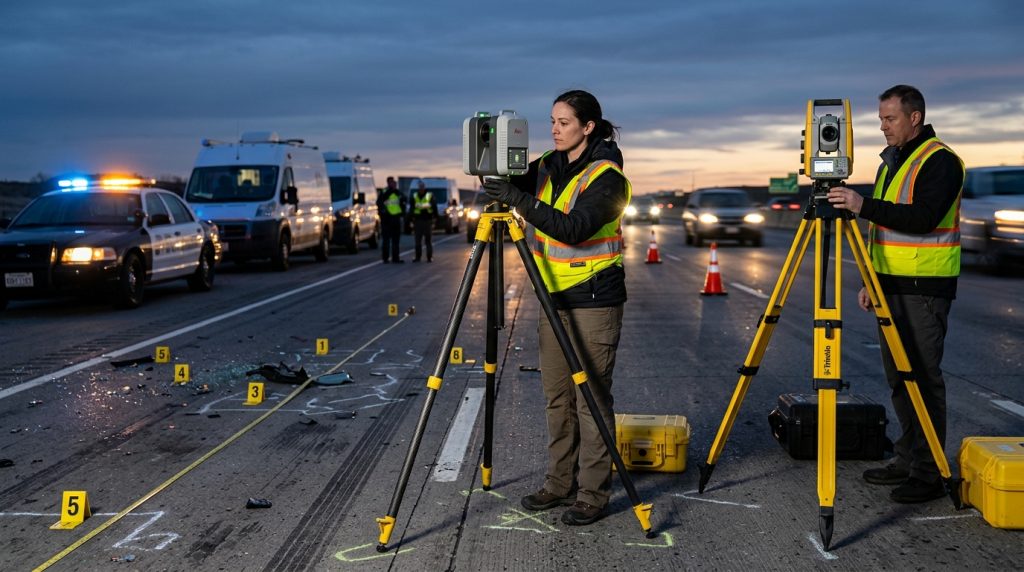
When high-impact motor vehicle collisions, catastrophic highway rollovers, or fatal commercial trucking incidents occur across New Brunswick, Nova Scotia, and Prince Edward Island, establishing factual liability requires rigorous physics rather than subjective eyewitness recollection. For insurance claim adjusters, self-insured municipal fleets, transportation carriers, and legal counsel, professional forensic accident investigation services provide the scientific foundation to resolve complex liability disputes and defeat fraudulent claims. How Does Forensic Motor Vehicle Accident Reconstruction Establish Fault in Atlantic Canadian Collisions? Direct Answer: Forensic Motor Vehicle Accident Reconstruction Forensic motor vehicle accident reconstruction applies classical Newtonian mechanics, linear momentum conservation, and digital electronic crash data analysis to objectively determine collision sequence, pre-impact vehicle speeds, braking timing, and driver inputs. Led by former RCMP forensic investigators, FPI Agency deploys certified Bosch Crash Data Retrieval (CDR) equipment and heavy vehicle Electronic Control Module (ECM) extraction tools across Atlantic Canada to download unalterable black-box telemetry, verify crush energy dynamics, and produce court-admissible reconstruction reports for insurance defense and civil litigation. From multi-vehicle pileups along the Trans-Canada Highway (Route 2) in New Brunswick to severe commercial freight collisions along the Cobequid Pass in Nova Scotia, physical roadway evidence degrades rapidly. Tire friction marks fade under traffic, adverse Maritime winter weather covers critical skid trails, and collision damage alters during towing. Immediate forensic dispatch ensures vital physical trace evidence and volatile electronic memory data are preserved before vital evidence is permanently lost. Electronic Event Data Recorders (EDR): Extracting the Digital ‘Black Box’ Modern passenger cars, light trucks, and heavy commercial tractors record immense streams of operational telemetry prior to, during, and immediately following a crash event. Our forensic investigators interface directly with vehicle electronic architecture to extract non-volatile diagnostic logs: Reconstruction Methodology Passenger Vehicle EDR (Bosch CDR) Heavy Commercial Truck ECM Physical Roadway Photogrammetry Hardware Module Interfaced Airbag Control Module (ACM / RCM) Engine Control Module (Detroit, Cummins, PACCAR) 3D Terrestrial Laser Scanner & Total Station Pre-Crash Parameters Captured Vehicle speed (5 sec @ 0.5s intervals), throttle %, brake switch, steering angle Sudden deceleration events, engine RPM, cruise control state, clutch switch Gouges, fluid trails, yaw marks, point of impact (POI), final rest coordinates Crash Severity Quantification Longitudinal & Lateral Delta-V ($\Delta V$), maximum crash pulse acceleration Vehicle speed change, brake application timing, hard-braking log timestamps Crush profile depth measurements, Energy Equivalent Speed (EES) analysis Extraction Interface OBD-II port or direct-to-module bench wiring Diagnostic 9-pin/6-pin Deutsch connector or breakout harness Survey-grade LiDAR point cloud & scaled aerial drone imagery Court Admissibility Fully accepted under Canadian Evidence Act Fully accepted with certified diagnostic chain Standard demonstrative trial exhibits Crash Kinematics & Mathematical Analysis Scientific accident reconstruction eliminates guesswork through established mathematical models. Our senior forensic specialists correlate physical vehicle inspection with roadway physical evidence to resolve pivotal questions: 1. Linear Momentum Conservation & Delta-V ($\Delta V$) Delta-V represents the cumulative change in velocity experienced by a vehicle during a collision. It is the universally recognized metric for quantifying impact severity and assessing occupant injury potential. By analyzing crush deformation profiles using the Campbell energy-deformation model and combining this with post-impact travel trajectories, we calculate precise pre-impact collision speeds, even when neither driver applied brakes prior to impact. 2. Tire Friction & Roadway Surface Drag Factors In Atlantic Canada, roadway friction changes drastically between dry asphalt, wet seal-coat, packed snow, and black ice. FPI Agency conducts on-site friction coefficient testing using calibrated electronic decelerometers. This empirical testing establishes exact drag factors ($f$), allowing accurate calculation of minimum pre-braking vehicle speed based on physical skid mark lengths ($S = \sqrt{30 \cdot d \cdot f}$). 3. Time-Distance & Sight-Line Perception-Response Analysis In pedestrian strikes, intersection collisions, and left-turn disputes, the core legal question frequently hinges on avoidability. Our investigators perform formal Perception-Response Time (PRT) evaluations. By mapping sight-line obstructions, streetlighting lux levels, headlight throw patterns, and vehicle approach velocities, we demonstrate whether a reasonably prudent driver possessed the requisite time and distance to avoid the impact. When insurance disputes involve suspected staged accidents or exaggerated personal injury claims, combining technical accident reconstruction with our certified insurance claims defense surveillance and polygraph truth verification provides an airtight legal defense. Chain of Custody & Court-Ready Litigation Support An accident reconstruction is only as valuable as its admissibility in court. FPI Agency enforces stringent evidence preservation protocols meeting all requirements of the Court of King’s Bench of New Brunswick and the Supreme Court of Nova Scotia: Direct-to-Module Forensic Extractions: When severe structural crush damage destroys vehicle electrical wiring, our technicians remove the airbag control module or engine ECM for direct bench-top power downloads, preventing volatile memory corruption. 3D Crash Scene Laser Mapping: We generate millimeter-accurate 3D digital point clouds of collision scenes, capturing roadway grades, superelevation, sight distances, and physical debris distribution before roads re-open to traffic. Comprehensive Expert Reports: We author detailed Rule 52 expert witness reports complete with velocity timeline charts, vector momentum diagrams, and high-resolution photographic appendices, supported by experienced forensic litigation testimony. Retain Atlantic Canada’s Forensic Accident Reconstruction Authority: Whether defending a multi-million-dollar commercial liability lawsuit, investigating a suspicious single-vehicle fatality, or reconstructing a complex intersection collision, precision matters. Contact Fidèle St-Amand and the senior forensic team at FPI Agency for immediate accident scene dispatch and electronic black box recovery across New Brunswick, Nova Scotia, and PEI.
Insurance Fraud Investigation & Claims Defense in New Brunswick: Surveillance & Forensic Audit
Insurance fraud is not a victimless crime: according to industry estimates, fraudulent and exaggerated claims cost Canadian insurers and policyholders billions of dollars annually. In New Brunswick, corporate risk managers, municipal authorities, and insurance underwriters face sophisticated fraud schemes ranging from exaggerated soft-tissue disability claims to staged motor vehicle collisions and suspicious commercial arson. Protecting policy reserves requires rigorous, court-admissible insurance fraud investigation and forensic claims defense. How Does an Insurance Fraud Investigation Work in New Brunswick? Direct Answer: Surveillance, Forensic Analysis & Subrogation Evidence In New Brunswick, insurance fraud investigations combine discreet mobile video surveillance, social media forensic audits, and technical accident reconstruction to verify claimant veracity. Conducted in strict compliance with PIPEDA privacy standards, investigators establish whether reported physical impairments or property losses match empirical reality, delivering time-stamped, court-admissible evidence to support claim denials, policy cancellations, or subrogation recovery before the Court of King’s Bench. At Forensic & Private Investigation (St-Amand) Agency, our investigators possess the unique combination of tactical field surveillance experience and formal forensic identification credentials (CFEI/FIS). This allows us to handle both standard disability surveillance and complex technical liability disputes with seamless evidentiary integrity. Four Major Pillars of Insurance Fraud Defense 1. WorkSafeNB & Long-Term Disability (LTD) Defense Exaggerated disability and workers’ compensation claims represent one of the heaviest ongoing liabilities for employers and insurers in New Brunswick: Activity Level Verification: Deploying multi-day mobile surveillance to document claimants engaging in physical labor, home renovations, sports, or secondary undeclared employment while claiming total temporary or permanent disability. Mobility & Assistive Device Audits: Documenting whether claimants who present with wheelchairs, canes, or braces at medical assessments discard these devices when in public view. Detailed Chronological Field Logs: Providing time-stamped video synchronized with minute-by-minute investigator notes to eliminate any claims of video manipulation or context misrepresentation. 2. Staged Vehicular Collisions & Low-Impact Fraud Organized fraud rings and opportunistic drivers frequently stage collisions or exaggerate minor parking lot scrapes into severe personal injury claims: Physical Damage vs. Injury Consistency: Evaluating crush depths, bumper heights, and paint transfers to verify whether the physical damage aligns with the reported collision dynamics. Pre-Existing Damage Verification: Differentiating between recent structural impact damage and oxidized, weathered, or prior collision damage claimed under a new policy incident. Delta-V & Kinematic Biomechanics: Conducting velocity calculations to demonstrate that vehicle acceleration forces were scientifically insufficient to cause the severe spinal or neurological injuries claimed. 3. Commercial Property & Suspicious Fire Loss (CFEI Origin & Cause) Suspicious structural and vehicular fires often involve complex financial distress or inventory inflation: Certified Fire Origin & Cause Analysis: Investigating fire scenes strictly in accordance with NFPA 921 and NFPA 1033 standards to determine whether fires were accidental, electrical, or incendiary (arson). Accelerant Detection & Sample Collection: Collecting fire debris samples under strict chain-of-custody protocols for gas chromatography analysis to detect liquid accelerants. Financial Motive & Alibi Verification: Correlating business financial statements, recent policy coverage increases, and claimant whereabouts during the ignition window. 4. Subrogation Investigation & Third-Party Liability Recovery When an insurer pays a substantial property or casualty claim, recovering funds from the responsible third-party manufacturer, contractor, or commercial tenant requires rapid evidence preservation: Scene preservation and non-destructive evidence gathering before site remediation begins. Identifying product defects, negligent maintenance, or contractor code violations that establish legal liability. Comprehensive subrogation dossiers formatted for immediate review by insurance litigation counsel. Evidentiary Comparison: FPI Forensic Agency vs. Internal Claims Audits Defense Parameter FPI Agency Forensic Investigation Standard Desk Claims Adjuster Unassisted Employer Review On-Site Tactical Surveillance Covert HD video & GPS-synchronized logs Desk review & phone interviews only Informal social media snooping Courtroom Admissibility 100% compliant with PIPEDA & King’s Bench Hearsay file documentation High risk of bad faith / privacy lawsuits Accident & Fire Reconstruction Certified CFEI & collision biomechanics Must hire expensive third-party engineers Unqualified personal opinion WorkSafeNB Appeal Standing Sworn investigator affidavits for WCAT Standard medical form objections Dismissal due to lack of objective proof Speak with an Insurance Defense Specialist Are you investigating a high-exposure disability claim, suspicious fire loss, or questionable vehicular collision in New Brunswick? Contact our corporate team for an immediate, confidential case assessment. 📞 Dispatch Direct: (506) 545-8665 ☎️ Office: (506) 783-8662 Request Claims Defense Review → Frequently Asked Questions How does covert surveillance legally prove insurance fraud in New Brunswick? Licensed private investigators conduct covert high-definition video surveillance in public spaces to document a claimant’s true physical capabilities over multiple days. If video evidence captures a claimant lifting heavy cargo, performing roofing labor, or engaging in strenuous recreation while receiving total disability benefits, the time-stamped video directly refutes claims of physical incapacity before courts and administrative tribunals. Is video evidence obtained during an insurance investigation compliant with Canadian privacy laws? Yes, provided the surveillance complies with PIPEDA and provincial privacy standards. Licensed investigators only record activities where there is no reasonable expectation of privacy (such as public streets, retail lots, and open outdoor spaces), avoiding intrusive measures like peering into private home windows. How do forensic accident reconstruction specialists identify staged vehicle collisions? Forensic investigators evaluate vehicle crush profiles, paint transfer patterns, collision contact angles, and Delta-V velocity changes against the reported crash narrative. Inconsistencies between vehicle damage and reported human injury forces readily identify pre-existing damage, deliberate sideswipes, or fabricated impact scenarios. Can an employer use independent fraud investigation reports to defend against WorkSafeNB claims? Yes. Objective forensic reports, time-stamped video surveillance, and coworker witness statements provided by a licensed agency give employers the admissible evidentiary foundation required to challenge exaggerated injury classifications or fraudulent worker compensation claims before the Workers’ Compensation Appeals Tribunal (WCAT).