Workplace Harassment & Bill C-65 Corporate Investigations
Chief Forensic Investigator’s Executive Brief: The Mandatory Employer Duty: Under federal Bill C-65 (Canada Labour Code, Part II) and Atlantic Canadian provincial Occupational Health and Safety Acts, employers have a strict statutory obligation to investigate all allegations of workplace harassment, sexual misconduct, and psychological violence. The In-House Conflict Trap: Conducting sensitive workplace investigations internally through HR or management exposes organizations to allegations of bias, breach of procedural fairness, and constructive dismissal lawsuits. Third-Party Neutral Credibility: Led by former RCMP investigators with decades of formal interview and forensic inquiry experience, FPI Agency delivers impartial, confidential, and court-ready workplace investigation reports across New Brunswick, Nova Scotia, and PEI. When formal allegations of workplace harassment, toxic leadership conduct, discrimination, or sexual harassment emerge within a corporation, crown entity, or municipal government, leadership faces immense organizational and reputational risk. How leadership responds determines whether the issue is resolved impartially or explodes into a multi-million-dollar wrongful dismissal lawsuit and public relations crisis. In-house human resources personnel, regardless of capability, are viewed by complainants and respondents as inherently conflicted agents of management. To ensure procedural fairness, protect corporate governance, and satisfy statutory compliance, boards of directors and executive leadership routinely retain independent, licensed third-party investigators. When Is an Independent Third-Party Workplace Investigator Legally Required? Direct Answer: An external investigator is required whenever complaints involve senior executives or HR personnel, where allegations present significant legal liability (e.g., systemic discrimination, sexual assault, or constructive dismissal), or where federal Bill C-65 / provincial OHS regulations mandate an impartial designated recipient. Independent investigation guarantees procedural fairness and insulates leadership from bad-faith claims. Canadian employment jurisprudence—including landmark rulings on bad-faith damages (such as Honda Canada Inc. v. Keays and Boucher v. Wal-Mart Canada Corp.)—has established that flawed, biased, or adversarial workplace investigations expose employers to substantial aggravated and punitive damage awards. Engaging a former police forensic investigator guarantees rigorous, unbiased fact-finding. Investigation Governance: In-House HR Review vs. Independent Forensic Investigation The comparative matrix below details the structural and legal protections of retaining FPI Agency for corporate investigations: Governance Dimension In-House HR / Management Review FPI Agency Independent Forensic Inquiry Corporate Risk Mitigation Perceived & Actual Bias High; HR reports directly to executive leadership Completely neutral; arms-length former RCMP investigator Eliminates conflict of interest and institutional bias arguments Investigative Interview Standard Informal conversation; unstructured note-taking Structured forensic cognitive interviewing with verbatim transcripts Withstands intense cross-examination at labor arbitrations & trials Evidence Synthesis & Burden Subjective feelings and office sentiment Balance of probabilities standard applying Faryna v. Chorny credibility tests Provides defensible factual basis for disciplinary or remedial action Statutory Compliance Vulnerable to procedural defects under Bill C-65 Full compliance with federal regulations & provincial OHS codes Insulates corporate directors from personal regulatory liability The 5-Stage Corporate Workplace Investigation Protocol FPI Agency executes corporate workplace investigations under a defined mandate tailored to client governance structures: Mandate & Terms of Reference: Formulating an unambiguous scope of inquiry with legal counsel or the board to establish boundaries and statutory obligations. Witness Interviews: Conducting confidential, recorded interviews with the complainant, respondent, and material witnesses, applying proven forensic interview techniques. Documentary & Digital Corroboration: Corroborating verbal testimony against internal emails, text logs, swipe card access data, and digital records using our digital forensics capabilities. Credibility Assessment: Evaluating conflicting witness accounts against real-world biological probability and contemporaneous records pursuant to established Canadian legal principles. Final Investigation Report: Delivering an exhaustive factual findings report with clear determinations on whether each allegation is substantiated, along with policy remediation recommendations. For inquiries where internal theft, asset diversion, or corporate embezzlement are suspected alongside workplace misconduct, review our corporate fraud & forensic accounting investigations. Retain an Independent Former-RCMP Workplace Investigator: To discuss a confidential corporate inquiry, executive misconduct file, or Bill C-65 workplace investigation mandate in New Brunswick, Nova Scotia, or PEI, contact Chief Investigator Fidèle St-Amand directly at (506) 545-8665 or submit your confidential terms of reference via our executive inquiry portal.
Forensic Motor Vehicle Accident Reconstruction in Atlantic Canada: Heavy Vehicle ECM Downloads, Bosch CDR ‘Black Box’ Retrieval & Crash Dynamics for Claims Defense
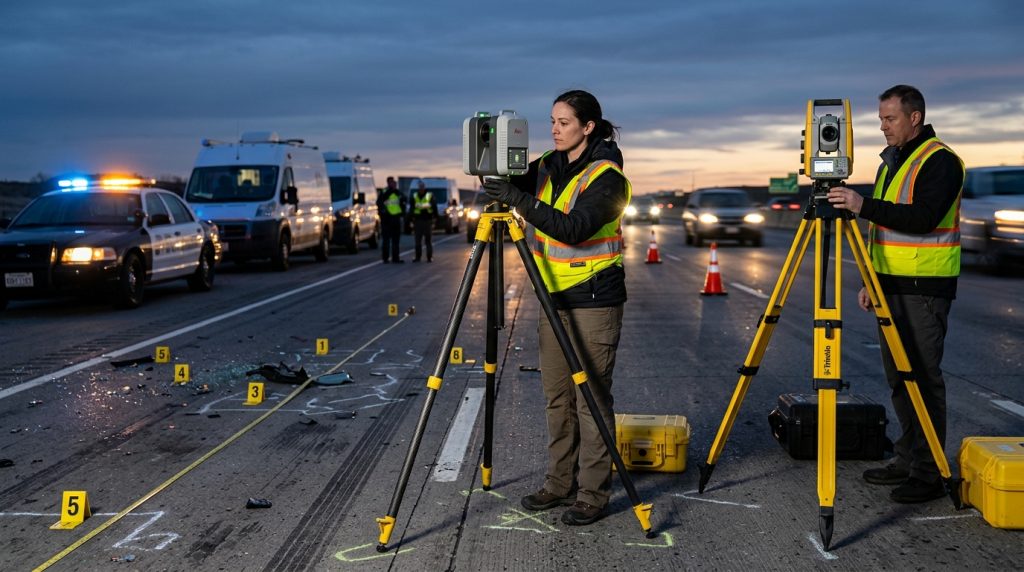
When high-impact motor vehicle collisions, catastrophic highway rollovers, or fatal commercial trucking incidents occur across New Brunswick, Nova Scotia, and Prince Edward Island, establishing factual liability requires rigorous physics rather than subjective eyewitness recollection. For insurance claim adjusters, self-insured municipal fleets, transportation carriers, and legal counsel, professional forensic accident investigation services provide the scientific foundation to resolve complex liability disputes and defeat fraudulent claims. How Does Forensic Motor Vehicle Accident Reconstruction Establish Fault in Atlantic Canadian Collisions? Direct Answer: Forensic Motor Vehicle Accident Reconstruction Forensic motor vehicle accident reconstruction applies classical Newtonian mechanics, linear momentum conservation, and digital electronic crash data analysis to objectively determine collision sequence, pre-impact vehicle speeds, braking timing, and driver inputs. Led by former RCMP forensic investigators, FPI Agency deploys certified Bosch Crash Data Retrieval (CDR) equipment and heavy vehicle Electronic Control Module (ECM) extraction tools across Atlantic Canada to download unalterable black-box telemetry, verify crush energy dynamics, and produce court-admissible reconstruction reports for insurance defense and civil litigation. From multi-vehicle pileups along the Trans-Canada Highway (Route 2) in New Brunswick to severe commercial freight collisions along the Cobequid Pass in Nova Scotia, physical roadway evidence degrades rapidly. Tire friction marks fade under traffic, adverse Maritime winter weather covers critical skid trails, and collision damage alters during towing. Immediate forensic dispatch ensures vital physical trace evidence and volatile electronic memory data are preserved before vital evidence is permanently lost. Electronic Event Data Recorders (EDR): Extracting the Digital ‘Black Box’ Modern passenger cars, light trucks, and heavy commercial tractors record immense streams of operational telemetry prior to, during, and immediately following a crash event. Our forensic investigators interface directly with vehicle electronic architecture to extract non-volatile diagnostic logs: Reconstruction Methodology Passenger Vehicle EDR (Bosch CDR) Heavy Commercial Truck ECM Physical Roadway Photogrammetry Hardware Module Interfaced Airbag Control Module (ACM / RCM) Engine Control Module (Detroit, Cummins, PACCAR) 3D Terrestrial Laser Scanner & Total Station Pre-Crash Parameters Captured Vehicle speed (5 sec @ 0.5s intervals), throttle %, brake switch, steering angle Sudden deceleration events, engine RPM, cruise control state, clutch switch Gouges, fluid trails, yaw marks, point of impact (POI), final rest coordinates Crash Severity Quantification Longitudinal & Lateral Delta-V ($\Delta V$), maximum crash pulse acceleration Vehicle speed change, brake application timing, hard-braking log timestamps Crush profile depth measurements, Energy Equivalent Speed (EES) analysis Extraction Interface OBD-II port or direct-to-module bench wiring Diagnostic 9-pin/6-pin Deutsch connector or breakout harness Survey-grade LiDAR point cloud & scaled aerial drone imagery Court Admissibility Fully accepted under Canadian Evidence Act Fully accepted with certified diagnostic chain Standard demonstrative trial exhibits Crash Kinematics & Mathematical Analysis Scientific accident reconstruction eliminates guesswork through established mathematical models. Our senior forensic specialists correlate physical vehicle inspection with roadway physical evidence to resolve pivotal questions: 1. Linear Momentum Conservation & Delta-V ($\Delta V$) Delta-V represents the cumulative change in velocity experienced by a vehicle during a collision. It is the universally recognized metric for quantifying impact severity and assessing occupant injury potential. By analyzing crush deformation profiles using the Campbell energy-deformation model and combining this with post-impact travel trajectories, we calculate precise pre-impact collision speeds, even when neither driver applied brakes prior to impact. 2. Tire Friction & Roadway Surface Drag Factors In Atlantic Canada, roadway friction changes drastically between dry asphalt, wet seal-coat, packed snow, and black ice. FPI Agency conducts on-site friction coefficient testing using calibrated electronic decelerometers. This empirical testing establishes exact drag factors ($f$), allowing accurate calculation of minimum pre-braking vehicle speed based on physical skid mark lengths ($S = \sqrt{30 \cdot d \cdot f}$). 3. Time-Distance & Sight-Line Perception-Response Analysis In pedestrian strikes, intersection collisions, and left-turn disputes, the core legal question frequently hinges on avoidability. Our investigators perform formal Perception-Response Time (PRT) evaluations. By mapping sight-line obstructions, streetlighting lux levels, headlight throw patterns, and vehicle approach velocities, we demonstrate whether a reasonably prudent driver possessed the requisite time and distance to avoid the impact. When insurance disputes involve suspected staged accidents or exaggerated personal injury claims, combining technical accident reconstruction with our certified insurance claims defense surveillance and polygraph truth verification provides an airtight legal defense. Chain of Custody & Court-Ready Litigation Support An accident reconstruction is only as valuable as its admissibility in court. FPI Agency enforces stringent evidence preservation protocols meeting all requirements of the Court of King’s Bench of New Brunswick and the Supreme Court of Nova Scotia: Direct-to-Module Forensic Extractions: When severe structural crush damage destroys vehicle electrical wiring, our technicians remove the airbag control module or engine ECM for direct bench-top power downloads, preventing volatile memory corruption. 3D Crash Scene Laser Mapping: We generate millimeter-accurate 3D digital point clouds of collision scenes, capturing roadway grades, superelevation, sight distances, and physical debris distribution before roads re-open to traffic. Comprehensive Expert Reports: We author detailed Rule 52 expert witness reports complete with velocity timeline charts, vector momentum diagrams, and high-resolution photographic appendices, supported by experienced forensic litigation testimony. Retain Atlantic Canada’s Forensic Accident Reconstruction Authority: Whether defending a multi-million-dollar commercial liability lawsuit, investigating a suspicious single-vehicle fatality, or reconstructing a complex intersection collision, precision matters. Contact Fidèle St-Amand and the senior forensic team at FPI Agency for immediate accident scene dispatch and electronic black box recovery across New Brunswick, Nova Scotia, and PEI.