
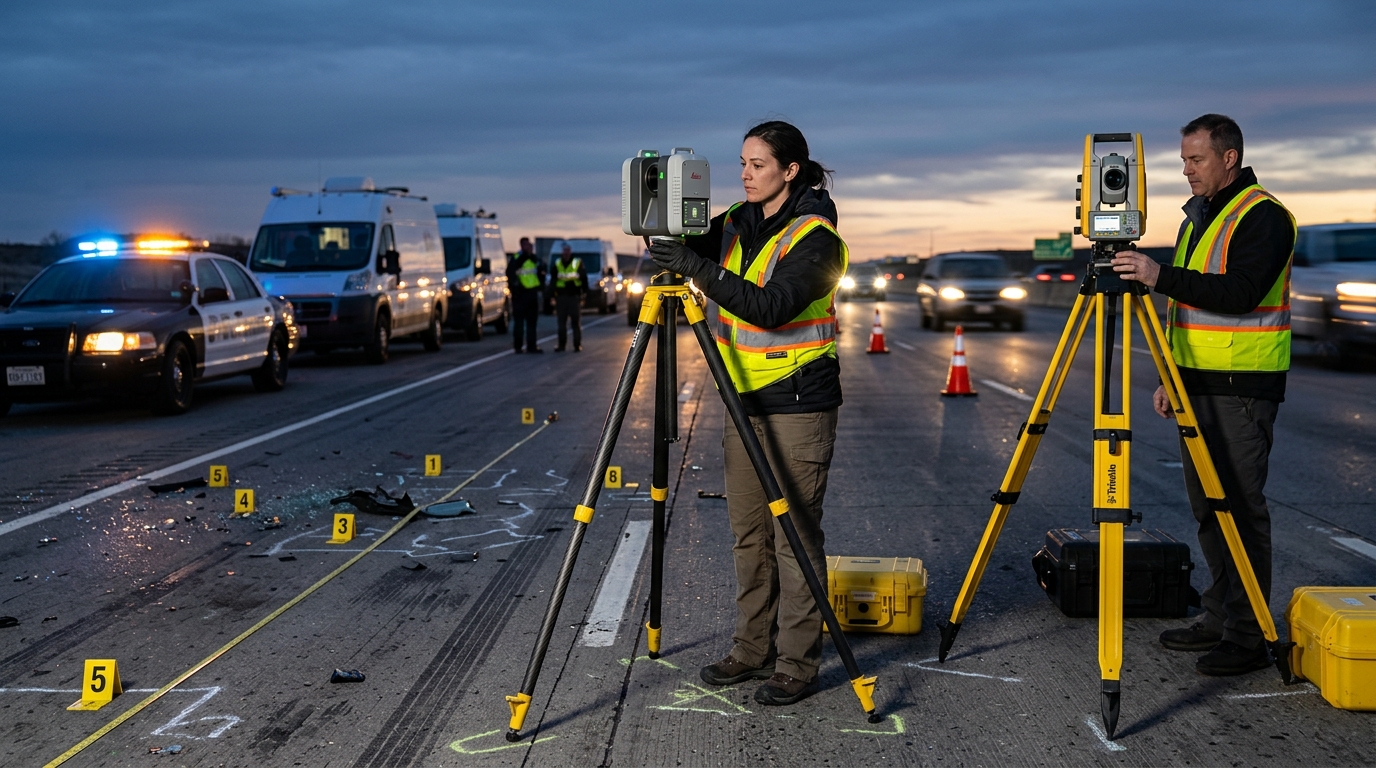
When high-impact motor vehicle collisions, catastrophic highway rollovers, or fatal commercial trucking incidents occur across New Brunswick, Nova Scotia, and Prince Edward Island, establishing factual liability requires rigorous physics rather than subjective eyewitness recollection. For insurance claim adjusters, self-insured municipal fleets, transportation carriers, and legal counsel, professional forensic accident investigation services provide the scientific foundation to resolve complex liability disputes and defeat fraudulent claims.
How Does Forensic Motor Vehicle Accident Reconstruction Establish Fault in Atlantic Canadian Collisions?
Forensic motor vehicle accident reconstruction applies classical Newtonian mechanics, linear momentum conservation, and digital electronic crash data analysis to objectively determine collision sequence, pre-impact vehicle speeds, braking timing, and driver inputs. Led by former RCMP forensic investigators, FPI Agency deploys certified Bosch Crash Data Retrieval (CDR) equipment and heavy vehicle Electronic Control Module (ECM) extraction tools across Atlantic Canada to download unalterable black-box telemetry, verify crush energy dynamics, and produce court-admissible reconstruction reports for insurance defense and civil litigation.
From multi-vehicle pileups along the Trans-Canada Highway (Route 2) in New Brunswick to severe commercial freight collisions along the Cobequid Pass in Nova Scotia, physical roadway evidence degrades rapidly. Tire friction marks fade under traffic, adverse Maritime winter weather covers critical skid trails, and collision damage alters during towing. Immediate forensic dispatch ensures vital physical trace evidence and volatile electronic memory data are preserved before vital evidence is permanently lost.
Electronic Event Data Recorders (EDR): Extracting the Digital ‘Black Box’
Modern passenger cars, light trucks, and heavy commercial tractors record immense streams of operational telemetry prior to, during, and immediately following a crash event. Our forensic investigators interface directly with vehicle electronic architecture to extract non-volatile diagnostic logs:
| Reconstruction Methodology | Passenger Vehicle EDR (Bosch CDR) | Heavy Commercial Truck ECM | Physical Roadway Photogrammetry |
|---|---|---|---|
| Hardware Module Interfaced | Airbag Control Module (ACM / RCM) | Engine Control Module (Detroit, Cummins, PACCAR) | 3D Terrestrial Laser Scanner & Total Station |
| Pre-Crash Parameters Captured | Vehicle speed (5 sec @ 0.5s intervals), throttle %, brake switch, steering angle | Sudden deceleration events, engine RPM, cruise control state, clutch switch | Gouges, fluid trails, yaw marks, point of impact (POI), final rest coordinates |
| Crash Severity Quantification | Longitudinal & Lateral Delta-V ($\Delta V$), maximum crash pulse acceleration | Vehicle speed change, brake application timing, hard-braking log timestamps | Crush profile depth measurements, Energy Equivalent Speed (EES) analysis |
| Extraction Interface | OBD-II port or direct-to-module bench wiring | Diagnostic 9-pin/6-pin Deutsch connector or breakout harness | Survey-grade LiDAR point cloud & scaled aerial drone imagery |
| Court Admissibility | Fully accepted under Canadian Evidence Act | Fully accepted with certified diagnostic chain | Standard demonstrative trial exhibits |
Crash Kinematics & Mathematical Analysis
Scientific accident reconstruction eliminates guesswork through established mathematical models. Our senior forensic specialists correlate physical vehicle inspection with roadway physical evidence to resolve pivotal questions:
1. Linear Momentum Conservation & Delta-V ($\Delta V$)
Delta-V represents the cumulative change in velocity experienced by a vehicle during a collision. It is the universally recognized metric for quantifying impact severity and assessing occupant injury potential. By analyzing crush deformation profiles using the Campbell energy-deformation model and combining this with post-impact travel trajectories, we calculate precise pre-impact collision speeds, even when neither driver applied brakes prior to impact.
2. Tire Friction & Roadway Surface Drag Factors
In Atlantic Canada, roadway friction changes drastically between dry asphalt, wet seal-coat, packed snow, and black ice. FPI Agency conducts on-site friction coefficient testing using calibrated electronic decelerometers. This empirical testing establishes exact drag factors ($f$), allowing accurate calculation of minimum pre-braking vehicle speed based on physical skid mark lengths ($S = \sqrt{30 \cdot d \cdot f}$).
3. Time-Distance & Sight-Line Perception-Response Analysis
In pedestrian strikes, intersection collisions, and left-turn disputes, the core legal question frequently hinges on avoidability. Our investigators perform formal Perception-Response Time (PRT) evaluations. By mapping sight-line obstructions, streetlighting lux levels, headlight throw patterns, and vehicle approach velocities, we demonstrate whether a reasonably prudent driver possessed the requisite time and distance to avoid the impact.
When insurance disputes involve suspected staged accidents or exaggerated personal injury claims, combining technical accident reconstruction with our certified insurance claims defense surveillance and polygraph truth verification provides an airtight legal defense.
Chain of Custody & Court-Ready Litigation Support
An accident reconstruction is only as valuable as its admissibility in court. FPI Agency enforces stringent evidence preservation protocols meeting all requirements of the Court of King’s Bench of New Brunswick and the Supreme Court of Nova Scotia:
- Direct-to-Module Forensic Extractions: When severe structural crush damage destroys vehicle electrical wiring, our technicians remove the airbag control module or engine ECM for direct bench-top power downloads, preventing volatile memory corruption.
- 3D Crash Scene Laser Mapping: We generate millimeter-accurate 3D digital point clouds of collision scenes, capturing roadway grades, superelevation, sight distances, and physical debris distribution before roads re-open to traffic.
- Comprehensive Expert Reports: We author detailed Rule 52 expert witness reports complete with velocity timeline charts, vector momentum diagrams, and high-resolution photographic appendices, supported by experienced forensic litigation testimony.
Whether defending a multi-million-dollar commercial liability lawsuit, investigating a suspicious single-vehicle fatality, or reconstructing a complex intersection collision, precision matters. Contact Fidèle St-Amand and the senior forensic team at FPI Agency for immediate accident scene dispatch and electronic black box recovery across New Brunswick, Nova Scotia, and PEI.